When it is time to replace a water heater, everyone asks the same question: should I go tankless? The sales pitch is real — endless hot water, a longer life, a smaller footprint. But the desert adds a wrinkle the pitch skips over.
Las Vegas hard water is hard on both types, and it changes the maintenance math in a way that matters. Here is the honest side-by-side, so you spend on the unit that actually fits your house and your habits.
How each one works
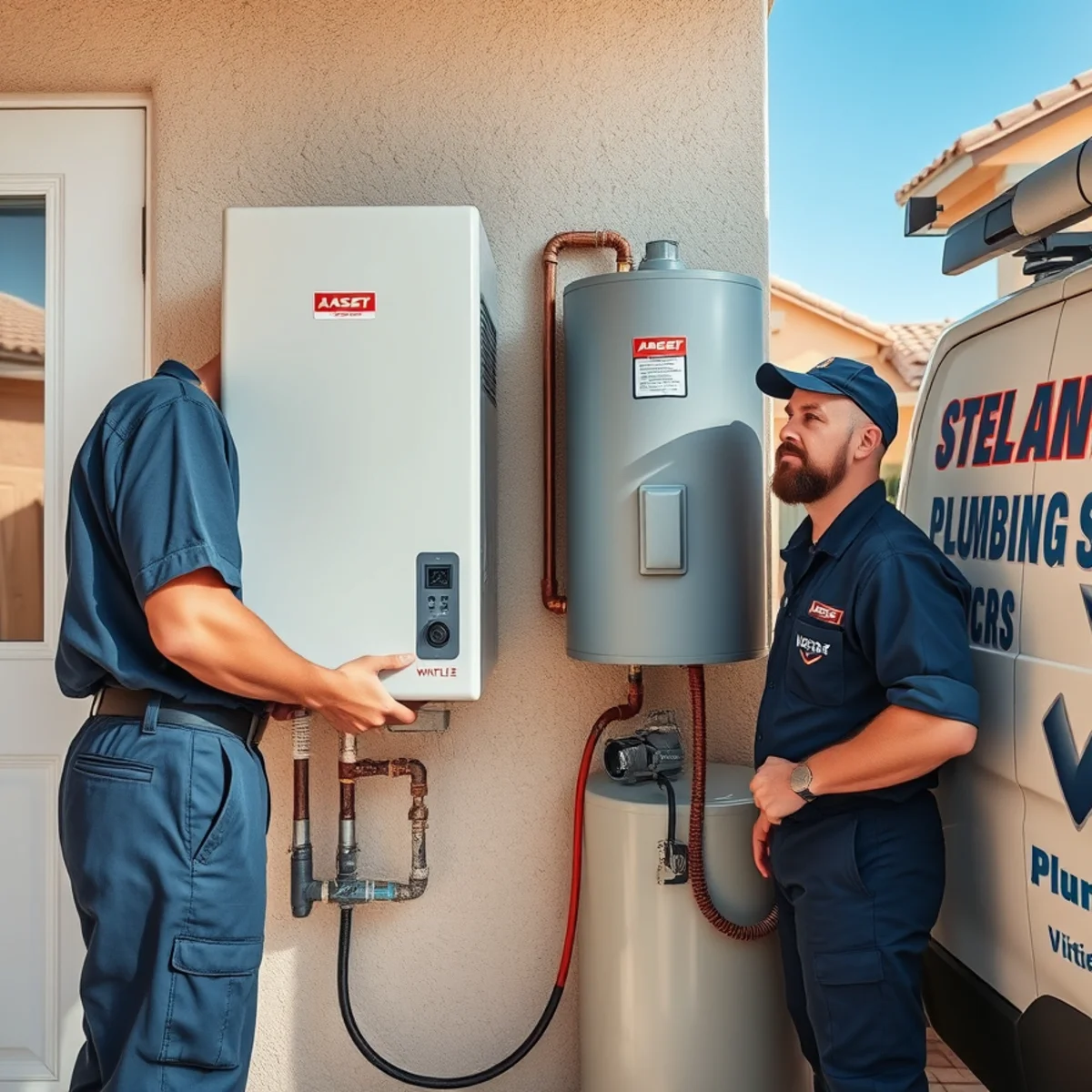
A tank heater keeps 40 to 75 gallons hot around the clock, ready to use. Simple, proven, cheaper to buy and install. The downside is standby loss — you pay to keep that water hot even when you are at work — and you can run the tank dry during back-to-back showers.
A tankless heater heats water only when you open a tap, firing a powerful burner or elements to warm water as it flows through. No standby loss, no running out, and a much longer service life. The trade-offs are a higher purchase and install cost and, here especially, stricter maintenance.
Lifespan: where tankless pulls ahead
A tank in Las Vegas often fails at 6 to 8 years because hard-water sediment cooks it from the bottom. A tankless unit, maintained, can run 15 to 20 years. That is roughly two tank replacements avoided.
But read the word maintained. A tankless heater does not have a big tank to hide sediment in — the scale collects in a narrow heat exchanger instead, and if it is ignored, our water will clog it in a couple of years. The long life is real only if you keep up with descaling.
The hard-water catch nobody mentions
This is the desert reality. At roughly 16 grains of hardness, valley water scales a tankless heat exchanger fast. A tankless unit here typically needs descaling once a year, sometimes more, versus every few years in soft-water regions.
Skip it and you get error codes, dropping output, and eventually a failed exchanger that costs more than the maintenance would have. The smart setup pairs a tankless unit with hard water treatment so the scale never gets a foothold. If you go tankless, budget for the upkeep — our tankless descaling walkthrough shows what is involved.
- Tank: flush yearly, replace anode, expect 6–8 years untreated
- Tankless: descale yearly, best paired with a softener, 15–20 years
- Both: last far longer when the water is treated first
Cost, up front and over time
A tank unit is cheaper to buy and install — often the better call if the budget is tight or you are replacing on short notice. A tankless unit costs more up front, and a first-time install may need gas line, venting, or electrical upgrades to feed that on-demand burner.
Over ten years the gap narrows. Tankless saves on energy by killing standby loss, and it outlasts a tank two-to-one here. Whether it pays back depends on how long you will stay in the home and how disciplined you are about maintenance.
Which fits your house
Go tankless if you plan to stay put for years, you run out of hot water now, you want the space back, and you will keep up with descaling — ideally behind a softener. Larger established homes in areas like Summerlin, where a family drains a tank every morning, are a natural fit.
Stick with a tank if you want the lowest up-front cost, you are replacing in a hurry, or the home is not set up for the gas and venting a tankless needs. There is no wrong answer — only the one that fits. When you are ready, we install and service both: a sized tankless system, or water heater repair and a right-sized tank — with a written price either way. If the tank you have is only a few years old and acting up, sometimes the smart move is a repair now and a planned upgrade later.
Talk to a Las Vegas plumber now
Open 24/7 for plumbing emergencies. Call for honest, up-front pricing.
Frequently asked questions
Does a tankless heater really never run out of hot water?
It never runs out the way a tank does, because it heats on demand. But each unit has a flow-rate limit — run too many hot fixtures at once and the temperature can dip. Sizing it correctly for your home's peak demand is what prevents that.
Is tankless worth it with Las Vegas hard water?
It can be, if you commit to yearly descaling and ideally run it behind a softener. The longer lifespan and endless hot water are real. Neglect the maintenance and our water will scale the heat exchanger and erase the advantage.
Can I switch from a tank to tankless in my home?
Usually yes, but it is more than a swap. A first-time install often needs gas line, venting, or electrical changes to support the on-demand burner. We assess your setup and give you the full cost before anything is ordered.
The bottom line
Tankless wins on lifespan and endless hot water; tank wins on up-front cost and simplicity — and in the desert, both live or die by how you handle the hard water. Tell us your home and your habits and we will point you to the right one. Ready to compare? Call (614) 830-0578.